
 Facebook
 X
X LinkedIn
 Forward
0867_CPMC_Neuroscience Symposium_Live
Description:
This one-day symposium is designed for a multidisciplinary neuroscience audience, including nurses and ancillary departments involved in the care of patients with neurological deficits related to stroke, tumors, or seizures. Participants will explore the clinical features, pharmacological management, and monitoring considerations for stroke and neurosurgical patients, while developing the skills to differentiate between acute care and rehabilitation needs across these populations. Through patient-centered case scenarios, attendees will strengthen their ability to analyze priority nursing interventions and build comprehensive care plans that integrate acute management strategies, rehabilitation goals, and medication considerations.
Assembly Bills 1195 & 241- Culturally Appropriate Care which is Free of Implicit Biases:
Learners are strongly encouraged to engage in self-directed learning related to the impact of implicit biases in this clinical area via the references provided below:
Learners are strongly encouraged to engage in self-directed learning related to the impact of implicit biases in this clinical area via the references provided below:
Hastings, P. D., Guyer, A. E., & Parra, L. A. (2022). Conceptualizing the influence of social and structural determinants of neurobiology and mental health: Why and how biological psychiatry can do better at addressing the consequences of inequity. Biological Psychiatry: Cognitive Neuroscience and Neuroimaging, 7(12), 1215-1224. - LINK TO ARTICLE
Faigle, R., & Towfighi, A. (2024). Advances in the understanding of social determinants of health in stroke. Stroke, 55(6), 1680-1682. - LINK TO ARTICLE
O'Halloran, R., Renton, J., Harvey, S., McSween, M. P., & Wallace, S. J. (2024). Do social determinants influence post-stroke aphasia outcomes? A scoping review. Disability and Rehabilitation, 46(7), 1274-1287. - LINK TO ARTICLE
Wolf, S., Holm, S. E., Ingwersen, T., Bartling, C., Bender, G., Birke, G., ... & Thomalla, G. (2022). Pre-stroke socioeconomic status predicts upper limb motor recovery after inpatient neurorehabilitation. Annals of medicine, 54(1), 1265-1276. - LINK TO ARTICLE
Bukhari, R., Graham, J., Kinney, A., Hoffman, A., & Malcolm, M. (2022). Social determinants of health and onset of rehabilitation services among individuals with traumatic brain injury. Archives of Physical Medicine and Rehabilitation, 103(12), e164-e165. - LINK TO ARTICLE
Bhat, A., Mahajan, V., & Wolfe, N. (2021). Implicit bias in stroke care: a recurring old problem in the rising incidence of young stroke. Journal of Clinical Neuroscience, 85, 27-35. - LINK TO ARTICLE
Arikawa, E., Kubota, M., Haraguchi, T., Takata, M., & Natsugoe, S. (2023). Implicit motor learning strategies benefit dual-task performance in patients with stroke. Medicina, 59(9), 1673. - LINK TO ARTICLE
Target Audience
Nurse Practitioner (NP)
Nurse, Registered (RN)
Pharmacists (PharmD)
Physicians (MD or DO)
Physical Therapists (PT)
Other Healthcare Professionals
Learning Objectives
By the end of this learning activity, participants will be able to:
1. Identify key clinical features of stroke and neurosurgical tumor patients.
2. Describe essential post-operative considerations for common neurosurgical procedures.
3. Explain the indications, mechanisms, and monitoring parameters for major neurological medications.
4. Perform focused neurological assessments to detect early signs of deterioration.
5. Differentiate between acute care and rehabilitation needs in stroke and neurosurgical populations.
6. Analyze patient scenarios to determine priority nursing interventions for neurological conditions.
7. Evaluate the safety and appropriateness of neurological pharmacologic regimens.
8. Develop patient centered care plans integrating acute management, rehabilitation goals, and medication considerations.
Course summary
- 6.00 ACPE
Pharmacy Credit - Accreditation Council of Pharmacy Education (ACPE)
Sutter Health designates this Live activity for a maximum of 6.00 of ACPE credit(s). Credits for pharmacists and technicians will be transmitted to CPE Monitor and will be available within 60 days post-activity pending submission of individual NABP e-PID and DOB (mm/dd only). Pharmacists should claim only the credit commensurate with the extent of their participation in the activity.
- 6.00 AMA PRA Category 1 Credit™
Physician Credit
Sutter Health designates this Live activity for a maximum of 6.00 AMA PRA Category 1 Credit™ for physicians. Physicians should claim only the credit commensurate with the extent of their participation in the activity.
- 6.00 Non-Physician Participation Credit
Sutter Health designates this Live activity for a maximum of 6.00 Non-Physician Participation Credit. Non-Physicians should claim only the credit commensurate with the extent of their participation in the activity.
AMA PRA Category 1 Credits HOURS™ Continuing Medical Education is acceptable for meeting the continuing education requirements for Pharmacists, Physician Assistants, Psychologists, Registered Nurses, and Respiratory Care Practitioners. For other disciplines, please check with the regulatory board for your discipline to confirm what type of credits meet the continuing education requirements. Continuing education hours for nurses accredited by ANCC, via Joint Accreditation.
- 6.00 ANCC
Nursing Credit - American Nurses Credentialing Center (ANCC)
Sutter Health designates this Live activity for a maximum of 6.00 ANCC contact hour(s). Nurses should claim only the credit commensurate with the extent of their participation in the activity.
- 6.00 CA BRN
Nursing Credit - California Board of Registered Nursing (CA BRN)
This activity is approved for 6.00 contact hour(s) by Sutter Health, which is an approved provider by the California Board of Registered Nursing. (Provider Number 17182). Nurses should claim only the credit commensurate with the extent of their participation in the activity. - 6.00 IPCE
This activity was planned by and for the healthcare team, and learners will receive 6.00 Interprofessional Continuing Education (IPCE) credit for learning and change.
- 6.00 PTBC
Physical Therapy Board of California
Sutter Health designates this Live activity for a maximum of 6.00 PTBC credit(s). Physical therapists should claim only the credit commensurate with the extent of their participation in the activity.
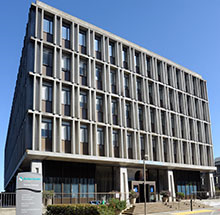
Located in San Francisco’s Duboce Triangle, CPMC Davies Campus is a nationally recognized hospital specializing in neurological, memory and rehabilitative care. Our campus is a Primary Stroke Center with a 24/7 emergency department and advanced surgical services, including robotic-assisted joint replacements, neurosurgery and plastic surgery.
Home to the Ray Dolby Brain Health Center, the CPMC Davies Campus offers specialized dementia and Alzheimer’s care, along with access to clinical trials that connect patients to the latest treatments. Our neuroscience specialists also treat stroke, epilepsy, ALS, brain tumors and movement disorders supported by leading-edge imaging and neurodiagnostics.
Recognized as one of America’s Best Physical Rehabilitation Centers by Newsweek, our CARF-accredited regional rehab program at CPMC Davies is a statewide leader in stroke recovery, brain and spinal cord injury rehab and complex condition management. With tailored inpatient and outpatient programs, our teams help you regain strength, independence and quality of life.
CPMC Davies Campus is deeply rooted in the San Francisco community, providing whole-person care and specialized behavioral health services. With an “A” grade in patient safety from The Leapfrog Group, your well-being is central to our mission. Through ongoing investments in modernization and expanded outpatient and partial hospitalization mental health services, CPMC Davies continues to evolve to meet the changing needs of our local community.
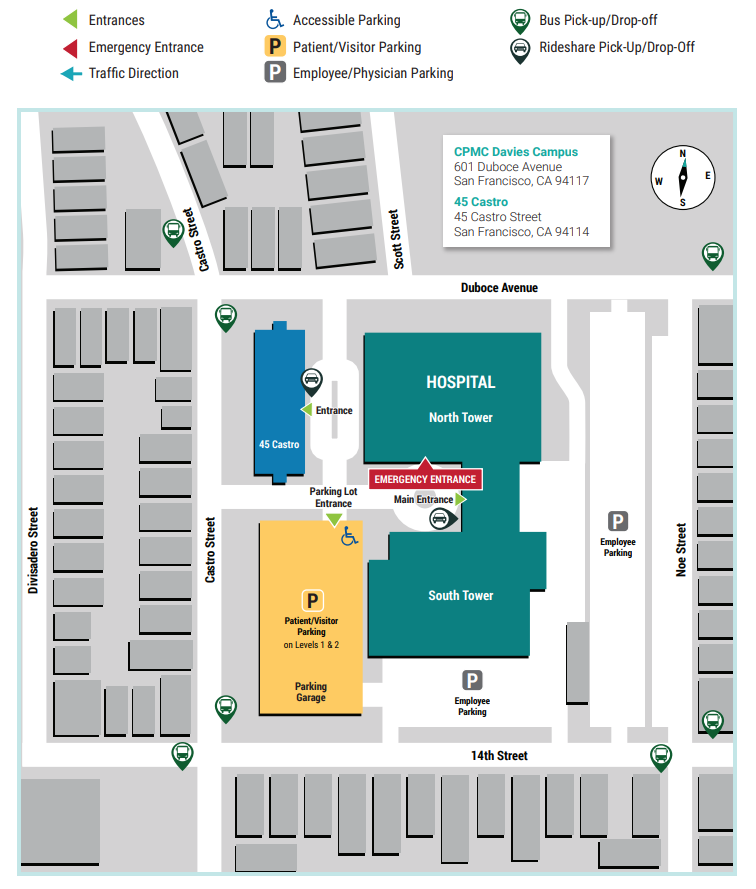
Travel
Parking
Street parking is available, but non-neighborhood residents are limited to two hours. For a fee, public parking is available in the CPMC garage located at 45 Castro Street. Parking is available 24 hours a day.
Public Transportation
The 24 Divisadero, 37 Corbett and the North Judah buses all stop within one block of the main hospital.
Campus Map
Disclosure of Financial or In-Kind Commercial Support & Conflict of Interest
No one involved in the planning or presentation of this educational activity have any relevant financial relationship(s) to disclose with ineligible companies whose primary business is producing, marketing, selling, re-selling, or distributing healthcare products used by or on patients. No financial or in-kind commercial support was received to produce or promote this educational activity.
– Provider Designee/Verification: Fozia Ferozali, Ed.D.
Rebekah Detrinidad, BSN, CCRN, CNRN
MADISON CONWAY, PT, DPT
Zachary Feingold, RN, ACNP
John Garfinkle, MS, CCC-SLP
Kate Hahner, Speech-Language Pathologist, M.S., CCC-SLP
Song Kim, MD
Marjereen Mirabueno, OTR/L, AIB-VR, CSRS, CBIS
Rana Moosavi
Jennifer Romani
Erin Samuelson, PharmD, BCPS

In support of improving patient care, Sutter Health is jointly accredited by the Accreditation Council for Continuing Medical Education (ACCME), the Accreditation Council for Pharmacy Education (ACPE), and the American Nurses Credentialing Center (ANCC), to provide continuing education for the healthcare team.
Credit Designation Statement
Sutter Health designates this LIVE activity for a maximum of 6.00 AMA PRA Category 1 Credits™ for physicians, 6.00 continuing professional development contact hours for nurses, 6.00 knowledge-based contact hours for pharmacists, and 6.00 approved continuing competency hours for physical therapists. Learners should claim only the credit commensurate with the extent of their participation in the activity.
Note to Other Disciplines: Non-Physician Participation Credit (AKA - AMA PRA Category 1 Credits HOURS™) Continuing Medical Education is acceptable for meeting the continuing education requirements for Pharmacists, Physician Assistants, Psychologists, Registered Nurses, and Respiratory Care Practitioners. For other disciplines, please check with the regulatory board for your discipline to confirm what type of credits meet the continuing education requirements. Continuing education hours for nurses accredited by ANCC, via Joint Accreditation.
Available Credit
- 6.00 ACPE
Pharmacy Credit - Accreditation Council of Pharmacy Education (ACPE)
Sutter Health designates this Live activity for a maximum of 6.00 of ACPE credit(s). Credits for pharmacists and technicians will be transmitted to CPE Monitor and will be available within 60 days post-activity pending submission of individual NABP e-PID and DOB (mm/dd only). Pharmacists should claim only the credit commensurate with the extent of their participation in the activity.
- 6.00 AMA PRA Category 1 Credit™
Physician Credit
Sutter Health designates this Live activity for a maximum of 6.00 AMA PRA Category 1 Credit™ for physicians. Physicians should claim only the credit commensurate with the extent of their participation in the activity.
- 6.00 Non-Physician Participation Credit
Sutter Health designates this Live activity for a maximum of 6.00 Non-Physician Participation Credit. Non-Physicians should claim only the credit commensurate with the extent of their participation in the activity.
AMA PRA Category 1 Credits HOURS™ Continuing Medical Education is acceptable for meeting the continuing education requirements for Pharmacists, Physician Assistants, Psychologists, Registered Nurses, and Respiratory Care Practitioners. For other disciplines, please check with the regulatory board for your discipline to confirm what type of credits meet the continuing education requirements. Continuing education hours for nurses accredited by ANCC, via Joint Accreditation.
- 6.00 ANCC
Nursing Credit - American Nurses Credentialing Center (ANCC)
Sutter Health designates this Live activity for a maximum of 6.00 ANCC contact hour(s). Nurses should claim only the credit commensurate with the extent of their participation in the activity.
- 6.00 CA BRN
Nursing Credit - California Board of Registered Nursing (CA BRN)
This activity is approved for 6.00 contact hour(s) by Sutter Health, which is an approved provider by the California Board of Registered Nursing. (Provider Number 17182). Nurses should claim only the credit commensurate with the extent of their participation in the activity. - 6.00 IPCE
This activity was planned by and for the healthcare team, and learners will receive 6.00 Interprofessional Continuing Education (IPCE) credit for learning and change.
- 6.00 PTBC
Physical Therapy Board of California
Sutter Health designates this Live activity for a maximum of 6.00 PTBC credit(s). Physical therapists should claim only the credit commensurate with the extent of their participation in the activity.